
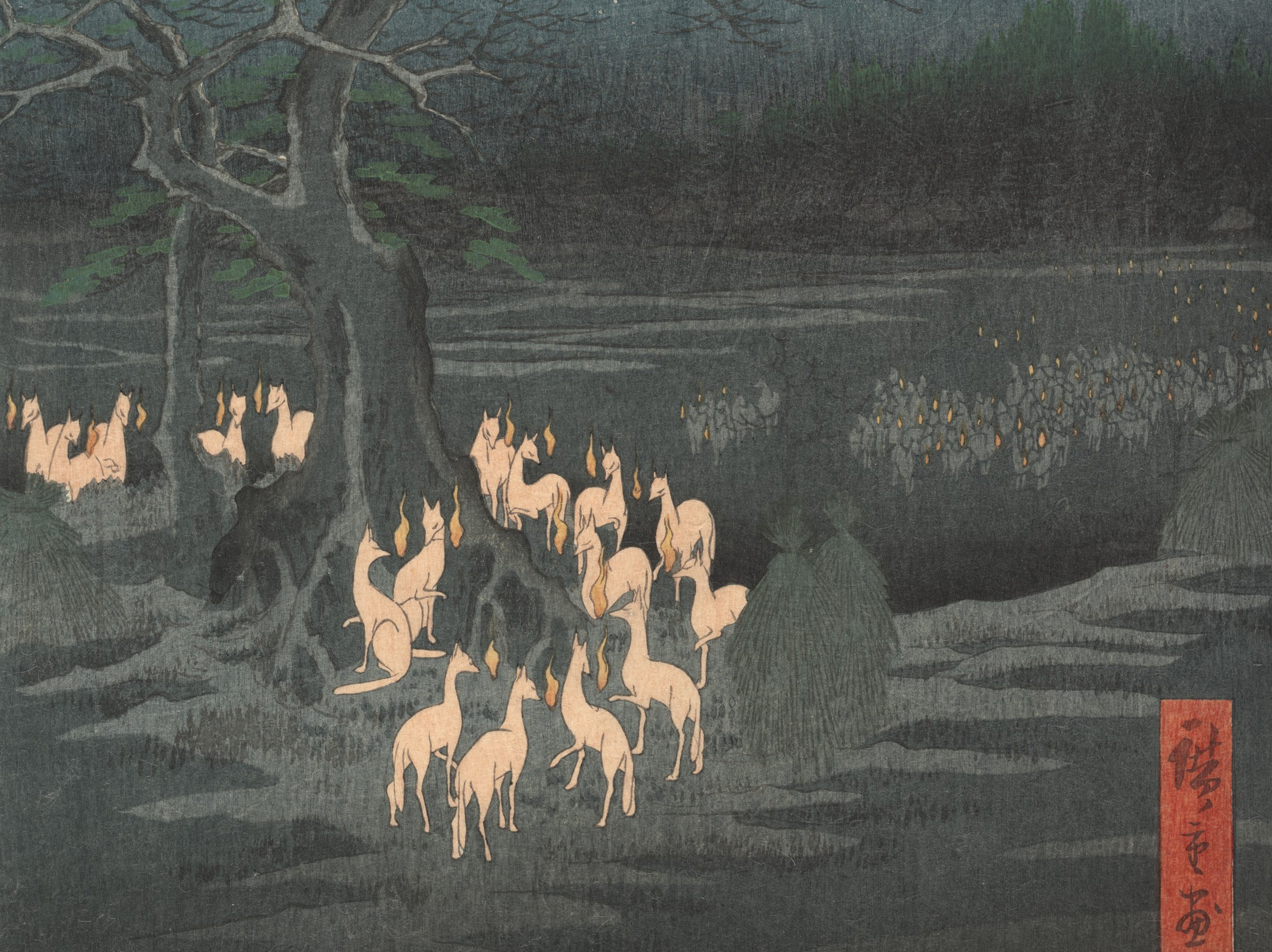
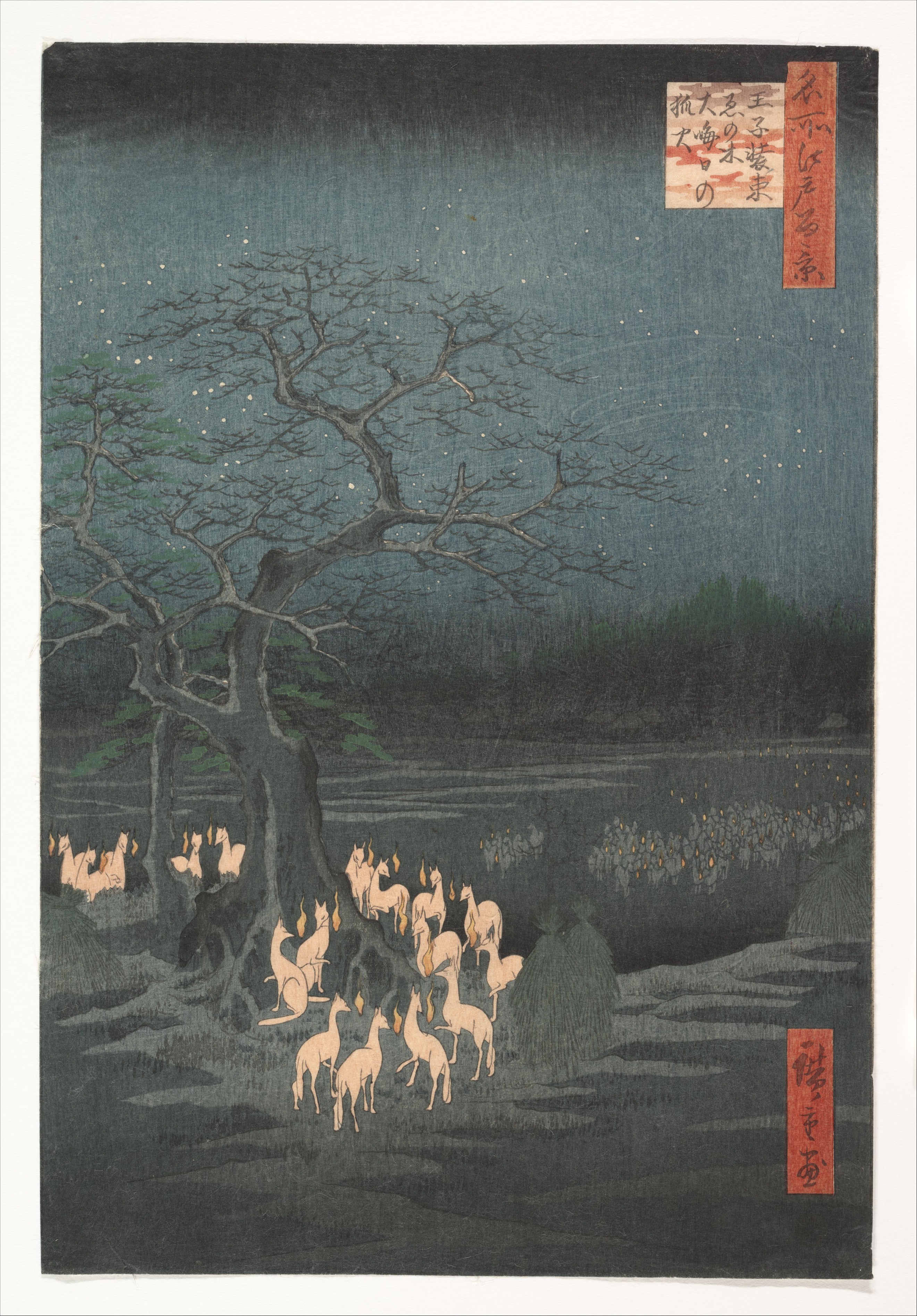
My short story, “Shiroki Sand Dunes” is a modern-day magical realism story inspired by an ukiyo-e print made in the Edo period. This woodblock print, New Year’s Eve Foxfires at the Changing Tree, Ōji, was created by one of the masters of Ukiyo-e, Hiroshige Utagawa, around 1857. The Met Museum website has a great write-up on this piece if you want to learn more about it.
The briefest TLDR to Ukiyo-e
A whole separate post could be dedicated to woodblock print style called ukiyo-e but I’m going to do the shortest TLDR ever but with links.
During the Edo period, publishers commissioned artisans in printing houses where they created mass-produced woodblock prints of popular subjects. Each print consisted of multiple carved wooden blocks. Prints were intended to be affordable to the general public. Images often depicted famous kabuki actors, sumo wrestlers, the pleasure districts, historical moments, views and mythology. For a quick primer on this iconic woodblock style read this intro by the Victoria and Albert museum. If you come to Japan, here’s alist of museums that focus on ukiyo-e. They are delicate prints and subject to fading but you can still buy original prints from the Edo period. People still create images with this technique so you can buy new prints using the ukiyo-e style.
The inspiration
New Year’s Eve Foxfires at the Changing Tree, Oji inspired my short story Shiroki Sand Dunes. This print has a kind of energy about it. It makes me think of a moment in life where something irrevocable is about to happen. It’s the kind of moment where you can feel the energy rising but might not know what it means.
In this story, I’m examining what happens when you feel something shift in your partner and you have to make huge life changes.
One of my favorite themes is how we fit into the world. In this story, it’s really about if humans can find a place in a world of spirits.
The location of the Utagawa’s print, Oji, is north of Tokyo. It is now part of Kita Ward in Tokyo. It’s also the home for one of the most famous fox parades in Japan—Kitsune no Gyoretsu at the Shozoku-Inari Jinja.
I chose to set my short story in a fictional location based on the sand dunes of Tottori prefecture on the Japan Sea coast of Honshu. It’s not a sweeping desert like the Sahara, but has tall sand dunes.
The ukiyo-e print gives me the impression of a moment stripped of everything—almost like a stage setting. Around the same time, I had visited Death Valley and seen skeletonized trees scoured by wind and sand, and that stark, heartbreaking landscape stayed with me when I wrote this story. I took liberties with the creation of the sand dunes because I wanted an empty, almost stage-like location where my characters were forced to confront one another and make difficult choices. I was drawn to the idea of an intensely isolated place, even more sparse than in Utagawa’s image.
“Shiroki Sand Dunes” is a magical realism/ urban fantasy story coming in 2026.
Lori Ravenford, writer of urban fantasy and liminal speculative fiction, has lived in Japan since 1995 and has a keen interest in Japanese culture and folklore. Learn more → About