
A moth sends her message into the night
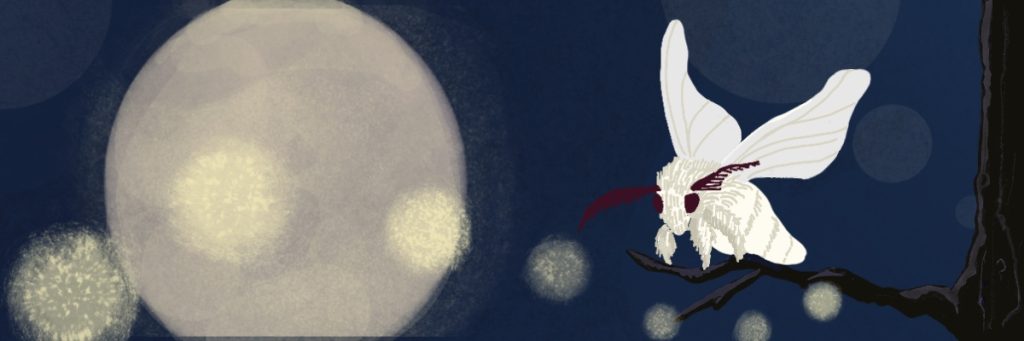
A lone moth perches delicately on a branch and emits her pheromones into the night breezes. She leaves her fate to chance, hoping that her one true love will find her so they can fulfill their mothly destinies. Somewhere in the distance, a male moth’s antennae twitches with recognition. They have never met, but She is out there.
Her mate must overcome distance and predators, who have learned that this precious scent can lead to a meal.
Moths are the origin story for paranormal tropes involving scenting and pheromones. I want to talk about the discovery of pheromones and how it infiltrated public discourse and showed up in paranormal romance. And it all started with a moth.
Moths and symbols of desire
Moths—especially nocturnal ones—mainly find mates through pheromones. Female moths release species-specific pheromones from glands at the end of their abdomen. Male moths sense these chemical signals through their feathery antennae and follow the wind and scent until they find the female.
The classic attraction tropes involving moths are fatal attraction (moth to a flame), the idea of secrets in the night, and fragility (moth wings). We’ve observed these behaviors for ages and used them as metaphors. We were right about the attraction—but we were missing where the real action was happening. It’s been sexy chemicals all along.
It’s not moth to a flame, but moth to a pheromone.
The discovery of pheromones
Did you know that the discovery of pheromones is as recent as 1959—and that it was first studied in silk moths? The term ‘pheromone’ was coined by Karlson & Lüscher the same year, after the chemical signal was isolated from Bombyx mori.
For some reason, I thought the discovery had happened much earlier—partly because humans have strong associations with scent, even if we don’t have the same innate abilities as moths. While humans may have some latent capacity to detect pheromones, our use of scent is largely performative. We rely on perfume, spices, flowers, and incense, linking smell to attraction, luxury, and memory. A keen sense of smell is often linked to animal instincts.
Pheromones take root in the public imagination
After the discovery of pheromones and continued research, the topic made its way into public discourse.
In the 1970s some studies indicated that women who spent time together would period sync due to pheromones. Though later studies called this into question. Studies also explored the potential role of pheromones and their mechanisms in sexual attraction. But even now, there is no set agreement on if humans are influenced by them or how.
But that idea of pheromones and the ability to manipulate them to influence others is simply too delicious in terms of marketing.
Any Gen-Xer might remember the Jovan Musk commercials that went on about animal attraction. More recently, Axe body spray promised to make men irresistible to women.
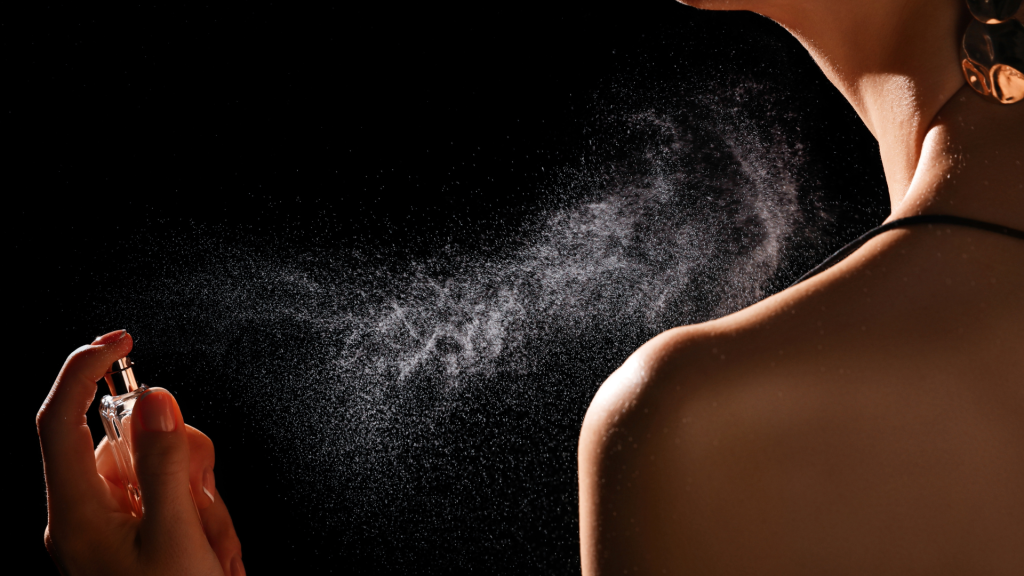
We could become sexy, subliminally influence others to find us sexually attractive by applying scent. It took on the tones of an animalistic love potion. The idea that our sexuality was heavily influenced, like subliminally, by scent. It wasn’t just about smelling pretty. It was something primal and instinctual.
The actual process of how humans are affected by scent is still not so well known. We don’t have moth antennae to receive the pheromone signals, nor do we have the olfactory equipment to really interpret pheromones.
Dogs get all sorts of information from scent and pheromones left by urine or emitted from other dogs. They have an olfactory organ called the Jacobson’s organ (vomeronasal organ). In the 1980s scientists learned how that organ allows them to process pheromones.
Humans are more like, “hey, you smell nice.” Cosmetic companies bank on this.
Animal attraction and marketing
Animal attraction is an effective marketing strategy, usually referring to mammals like wolves. But pheromones were discovered first in moths, yet they don’t get the credit. Why? Probably some bias against moths. Animal equals mammal, and bugs are generally not considered sexy.
The idea of pheromones is, I think, an underrepresented part of human sexuality in literature. We talk about smell, sure—but how much do pheromones really affect us day to day? I’m sure there’s research somewhere; it just feels like we don’t have as deep an understanding of that scent yet.
There’s that fact floating around the internet that humans are more attuned to the scent of petrichor than a shark is to blood in the water—so we do have scent sensitivity. But how much of that plays into attraction is still a bit of a mystery.
Story time
I used to date a guy that I thought smelled weird. His hygiene was fine so I thought I was overreacting. But then I found a men’s cologne that smelled like him (I think it was Chanel Egoiste) and it struck me, there are people in the world that find this scent attractive. We need to break up so he can find someone who finds his scent attractive.
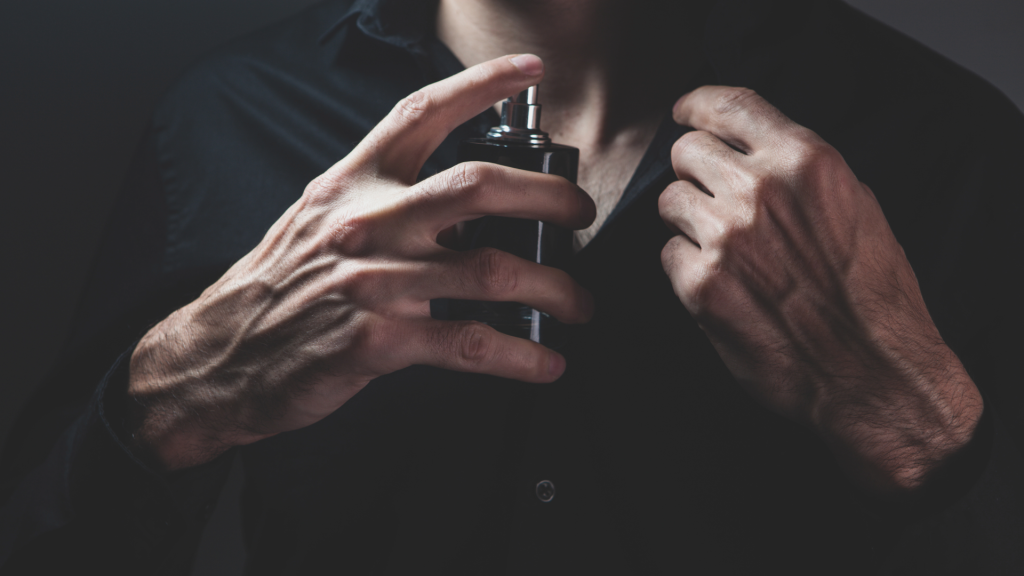
It turns out my husband smells like my favorite cologne (Fahrenheit) even though he refuses to wear scent of any type. Is it just scent and memory or is this something deeper? Is this the kind of invisible pull between people that moths rely on? How does this personal chemistry tie back to pheromones—and to paranormal romance?
So how do pheromones relate to paranormal romance?
Stories have a long tradition of using scent to signal love and attraction. It’s been linked to animals to symbolize the base nature of human lust, and to perfume as a marker of allure and identity. Folklore and mythology also have a long-standing tradition of fated mates.
But after the discovery of pheromones in 1959, there was more discussion in popular culture about how scent plays a role in human attraction—think ads for musk perfumes, for instance. And when PNR shifters became a popular genre, I think the zeitgeist made the mechanism of fated mates feel more grounded in fact (though still fully in the realm of paranormal) and less like airy-fairy magic MacGuffin.
A great MacGuffin
Using scent in this pheromone inspired way is still a MacGuffin—but it’s a good one. I like that there is some science behind it, even if it’s not well understood yet. The scent element also emphasizes the animal nature of shifter romances.
Which creatures use pheromones and scent marking?
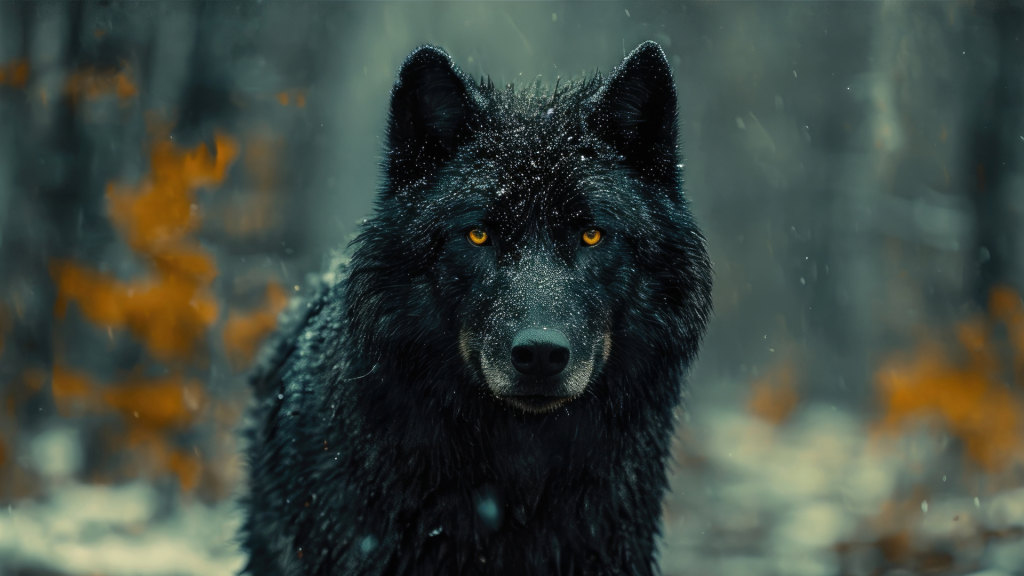
Top paranormal creatures using scent? The survey says… Werewolf! Ding, ding, ding. At number one! Actually, I’m just guessing. But it is one of the most common. Shifters of all sorts use this basis of animal attraction. Identifying your mate, scent recognition, understanding the health of your mate through scent are common tropes.
The Omegaverse is a genre that features characters (and not just werewolves or shifters) in a hierarchy of alphas, betas, and omegas. Scent marking is a key trope—fated mates recognize each other by scent, though the mechanism is rarely explained. Here, scent becomes both communication and hierarchy—a literal language of desire.
Famously, vampires are attracted to the scent of blood and repelled by garlic. But that’s not pheromones. In The Vampire Chronicles series by Anne Rice or Charlaine Harris’s Sookie Stackhouse novels, pheromones sometimes serve as tools to manipulate the actions of other characters.
Ice Planet Barbarians by Ruby Dixon uses scent and pheromones to great effect. Dixon did a great job with her story line that puts human females on an alien planet. Lots of sexy times, too.
Using scent tropes is not limited to any kind of creature. All it takes is an author who can imagine it into being.
Fairies, too?
In one of my WIPs set in the Rivershade world, fairies don’t play tricks for fun. They use humans for their food source. The fairies use little pheromone darts (inspired by Cupid’s bow) to influence their target into generating the emotions they harvest to survive. These fairies are a bit like if the angel and devil sitting on your shoulder were chemists.
Two cadres of fairies wage a quiet war for influence: one thrives on darker emotions and stress, the other cultivates love, tenderness, and care. Catch the attention of the first, and your days twist into a chain of unlucky turns. Draw the gaze of the second, and life seems charmed—until you realize that both are harvesting your feelings to survive.
Wrap Up
What do you think? Do moth mating pheromones form the basis of some paranormal romance? I see a correlation—but correlation isn’t always causation.
I do think the discovery of moth pheromones brought the idea of scent and pheromonal attraction into the public consciousness. Most people have at least heard of pheromones. The addition of this concept in the cultural zeitgeist adds a layer of realism to paranormal romance that helps to immerse the reader and prepare them for a world where the impossible is possible. In paranormal romance, desire isn’t arbitrary—scent becomes more than a plot device, guided by chemical destiny. And it all started with a moth.
Remember, it’s a moth’s world!
Part of the Mothing 101 series by Lori Ravenford, writer of urban fantasy and liminal speculative fiction. Learn more → About
Some of the articles I read when writing this
The Psychology Behind Paranormal Romance: Why Are We Drawn to Shifters? — Sydney Addae (October 16, 2025)
https://sydneyaddae.com/the-psychology-behind-paranormal-romance-why-are-we-drawn-to-shifters-2/
Pheromones — American Psychological Association (APA)
https://www.apa.org/monitor/oct02/pheromones
How Moths Find Their Flame: Discovering Genetics of Mate Attraction — Tufts Now
https://now.tufts.edu/2021/05/17/how-moths-find-their-flame-discovering-genetics-mate-attraction
Pheromones — NCBI Bookshelf (biological overview/context)
https://www.ncbi.nlm.nih.gov/books/NBK200980/
Is it Time We Sniffed Out the Real Human Pheromones? — British Society for Phenomenology
https://bsp.org.uk/is-it-time-we-sniffed-out-the-real-human-pheromones-pia-long/
Any mistakes in this article are mine.
Images from Adobe Stock and Deposit Photo except the moth drawing done by me.